

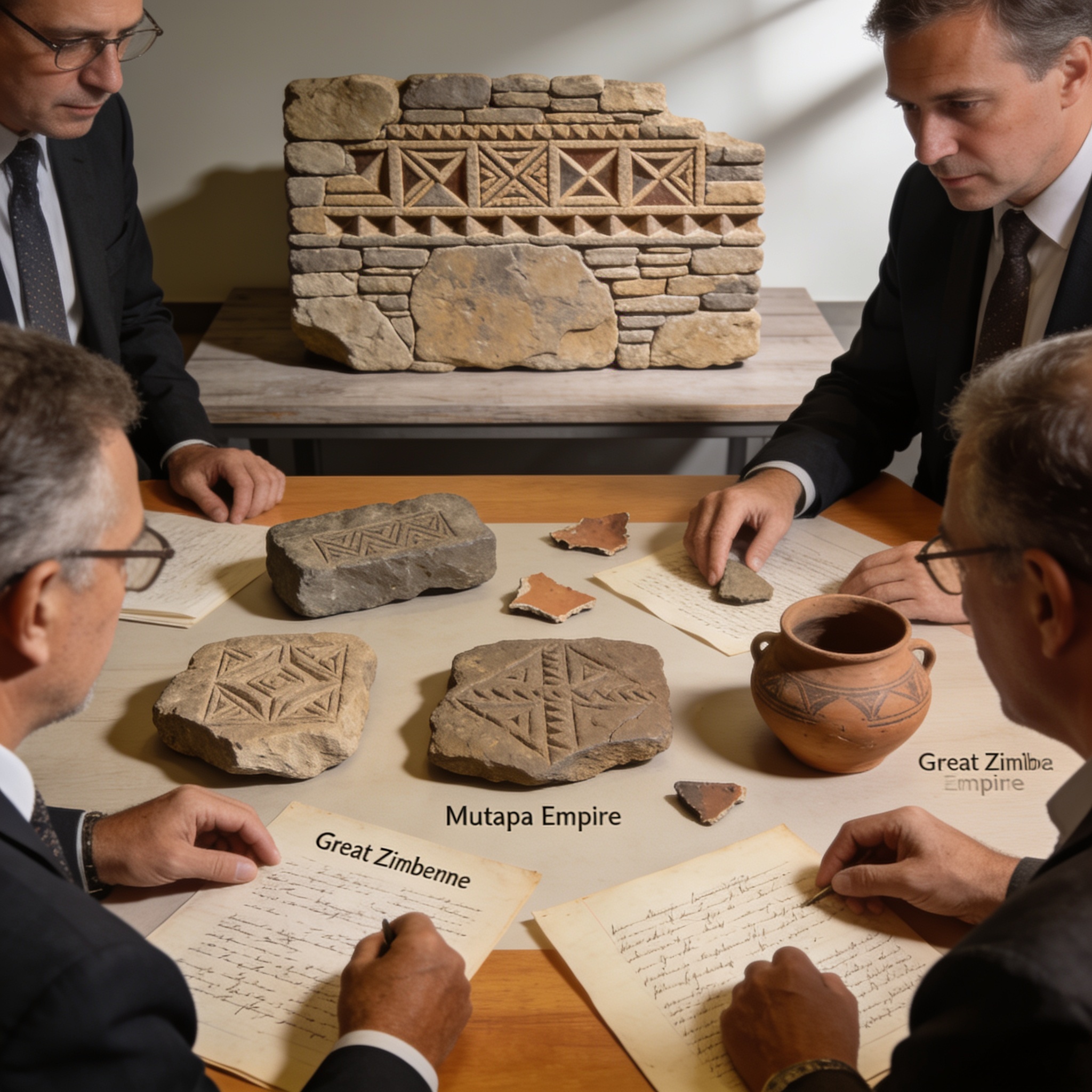
Zimbabwe’s newest public holiday has reopened an uncomfortable argument about how the country tells the story of its own past. At events marking the first Munhumutapa Day, a senior Zanu-PF official told supporters that the Mutapa Empire was responsible for building Great Zimbabwe, while a cabinet minister described the decision to place the holiday on September 15 — the same date as President Emmerson Mnangagwa’s birthday — as nothing more than a coincidence.
Both claims have drawn sharp pushback from writers, historians and heritage specialists, who say they flatten centuries of distinct history into a convenient political narrative.
The claim about Great Zimbabwe
Zanu-PF Youth League leader John Paradza used his address at a Munhumutapa Day gathering to assert that the Mutapa Empire constructed the stone city whose ruins still stand in Masvingo Province. The statement was framed as a way of rallying Zimbabweans around a proud pre-colonial legacy.
The difficulty is chronological. Archaeological and documentary evidence places Great Zimbabwe at its height between the 11th and 14th centuries, when it functioned as a major centre of stone masonry, cattle pastoralism and long-distance trade reaching the Indian Ocean. By the time the Mutapa state took shape around 1430, Great Zimbabwe was already sliding into decline and gradual abandonment.
The founder of the Mutapa polity, Nyatsimba Mutota, is understood to have moved north into the Dande and Zambezi Valley areas in search of salt and new trade routes as pressures mounted in the south. His followers did not arrive in an empty region. The state that became the Mutapa Empire was assembled through alliances, negotiation and the incorporation of communities already living there, including the Tavara and local spirit mediums whose religious authority helped legitimise the new rulers.
Treating the Mutapa Empire as simply Great Zimbabwe relocated — or crediting it with building the earlier city — erases the separate identities, timelines and achievements of societies that were never a single political project.
The ‘coincidence’ that was not
The second controversy concerns the date itself. Lands, Agriculture, Fisheries, Water and Rural Development Minister Anxious Masuka told a gathering at Pricabe Farm, in front of cabinet ministers and traditional leaders, that September 15 had aligned with the President’s birthday by accident.
Critics point out that the holiday did not emerge from any established national or historical calendar. It was created by Statutory Instrument 148 of 2026, signed under presidential powers. A coincidence normally requires a date to exist independently of the person who benefits from it — a child born on Christmas Day, or an anniversary falling on Independence Day. Drawing the target around your own arrow is a different exercise altogether.
Nothing in the documented record ties September 15 to the Munhumutapa dynasty. Portuguese archives, by contrast, record several datable moments in the empire’s history: the large-scale revolt led by Munhumutapa Kapararidze in August 1631, and November 14, 1693, when Munhumutapa Nyakunembire and Changamire Dombo overran the Portuguese trading post at Dambarare.
If the intention was genuinely to honour the empire, such dates offered a defensible foundation. Choosing a day with no connection to it suggests the calendar was built around the presidency rather than around history.
Why the argument matters beyond symbolism
Public holidays shape what schoolchildren learn, what museums display and what tour guides tell visitors. Great Zimbabwe is a UNESCO World Heritage Site and the single most recognised archaeological monument in the region. Its interpretation is not a trivial matter of trivia.
Collapsing independent civilisations into one continuous storyline also carries a political function. It allows modern state authority to be presented as the natural heir to ancient kings — a form of borrowed legitimacy for an administration that has struggled to deliver on jobs, health services, reliable electricity and infrastructure.
Pre-colonial Zimbabwe was sophisticated precisely because it was varied: different polities, different trade networks, different systems of spiritual and political authority. That complexity is more impressive than any flattened fable.
Zimbabweans are entitled to take pride in Great Zimbabwe and in the Mutapa state. But the two deserve to be remembered for what they actually were — and that begins with respecting the dates, the archaeology and the people whose stories do not fit neatly onto a party podium.