

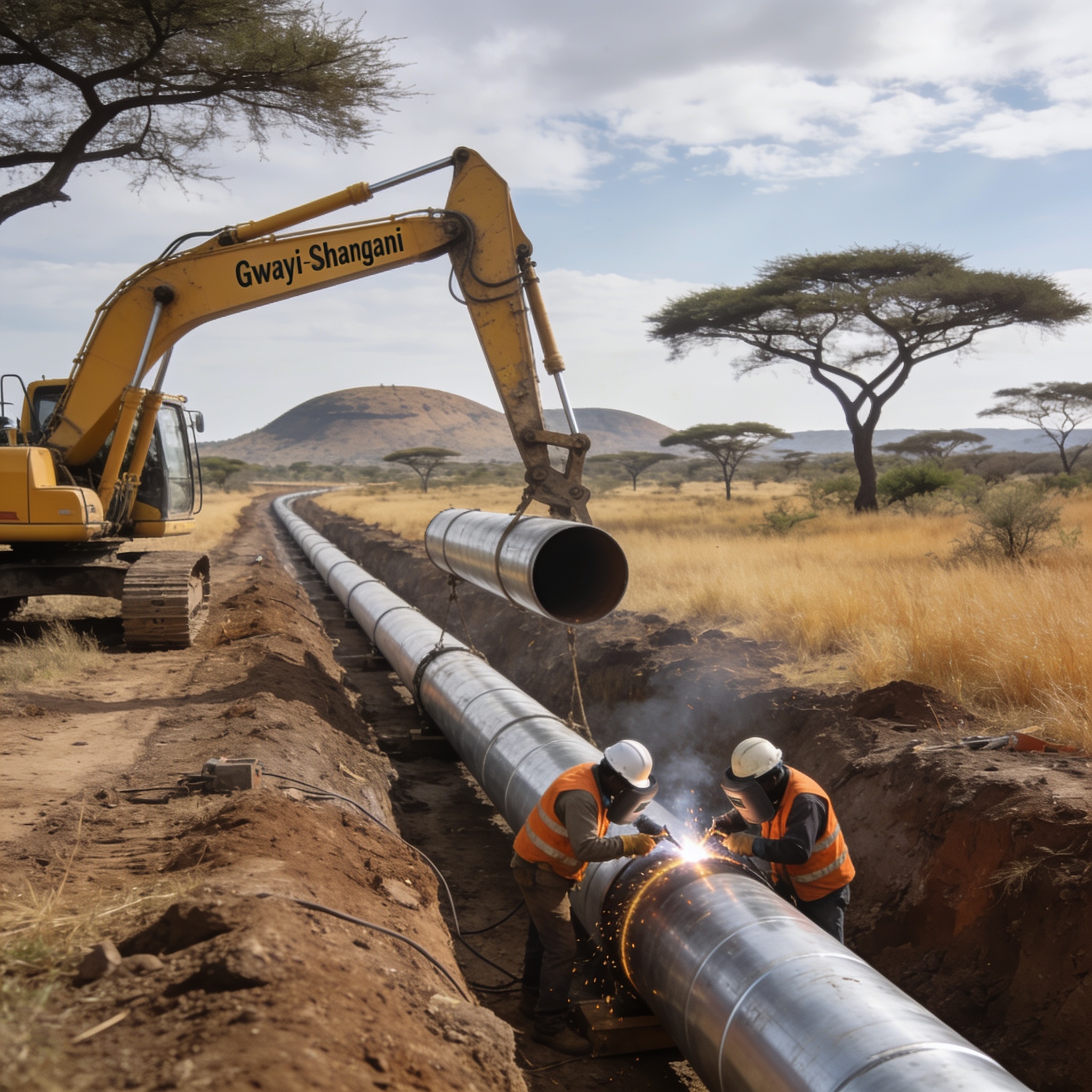
Bulawayo mayor David Coltart has warned that the 252-kilometre pipeline designed to carry water from Gwayi-Shangani Dam to the city would take more than two centuries to build if Treasury keeps releasing money at the rate recorded last year.
The mayor’s calculation has renewed scrutiny of the widening gap between visible progress on the dam and the far slower work on the pipes, pumps and treatment infrastructure needed to actually move water to Bulawayo’s taps.
A 217-year timeline at current funding levels
Coltart said the Zimbabwe National Water Authority (ZINWA) had put the pipeline’s price tag at about US$543 million, while only roughly US$2.5 million was spent on that section of the project last year.
“If that disbursement rate isn’t improved it will take 217 years to build the pipeline,” the mayor said in comments posted on X, describing a multi-century delivery schedule as the natural consequence of a financing plan that has never matched the scale of the engineering.
He welcomed news that civils work on a 10-megawatt mini-hydropower station at Gwayi-Shangani is advancing, but stressed that the City of Bulawayo’s priority remains the pipeline itself.
Contract packages total more than US$554 million
Figures published earlier this year by CITE put the combined value of the four main contract packages under the National Matabeleland Zambezi Water Project (NMZWP) at US$554.44 million, based on a progress report dated 10 July 2026.
- Pipeline construction: US$175.14 million
- Booster pump stations: US$167.73 million
- Water treatment plant: US$81.25 million
- Pipe supply: US$130.33 million
According to the same report, the pipeline itself stands at about 16 percent completion, while the booster pump stations are only around 18 percent done.
Construction was awarded to 12 contractors in March 2022, each handling roughly 21 kilometres, but work stalled within the same year as funding failed to flow consistently. Once finished, the pipeline is meant to deliver 220 megalitres of raw water a day to Bulawayo.
Dam races ahead of the delivery network
Gwayi-Shangani Dam is far closer to the finish line than the system intended to serve the city. The 2026 Zimbabwe Infrastructure Investment Programme recorded US$25.3 million released for dam construction during 2025, when the structure was reported to be 72.4 percent complete, with completion projected for 2026 backed by a ZiG273 million allocation.
The 10MW mini-hydropower station has also moved forward. Assistant Resident Engineer Joakim Banda has said civil works at the plant are about 75 percent complete, with the remaining civils expected to wrap up within the current reporting year before electro-mechanical installation begins.
Coltart’s concern is that these milestones do not translate into water for residents. Without funded pipelines, pumping stations and treatment works, a finished dam wall remains an asset without a delivery route.
Budget allocations dwarfed by the cost gap
The 2025 National Budget set aside ZiG1 billion for the broader Gwayi-Shangani scheme, split between ZiG700 million for the dam and ZiG282 million for the Bulawayo pipeline — worth roughly US$38.7 million at the official interbank rate used at the start of that year.
For 2026, the government allocated ZiG273 million to Gwayi-Shangani as a whole, equivalent to about US$10.7 million at the prevailing official exchange rate, alongside ZiG30 million each for the pipeline and the booster pump station.
President Emmerson Mnangagwa previously directed Treasury to release US$5 million a month towards strategic dam projects. Treasury later reported that US$2.39 million had gone to the pipeline, compared with US$25.3 million for the dam. The latest project report suggested US$4 million a month is only enough to keep the dam wall moving, and recommended lifting monthly funding to US$8 million to cover the mini-hydro station and low-lift pump stations as well.
Logistics add to the pressure
The July progress report also flagged poor road conditions on the Bulawayo–Victoria Falls highway, which has contributed to breakdowns among heavy vehicles hauling construction materials to the site.
The NMZWP was first mooted more than a century ago, and its backers have long promised that it would secure Bulawayo’s water supply while opening up irrigation and industrial development across Matabeleland.
Coltart’s arithmetic suggests that promise will remain theoretical unless the financing model for the pipeline, pump stations and treatment plant is fundamentally reworked — and soon.