

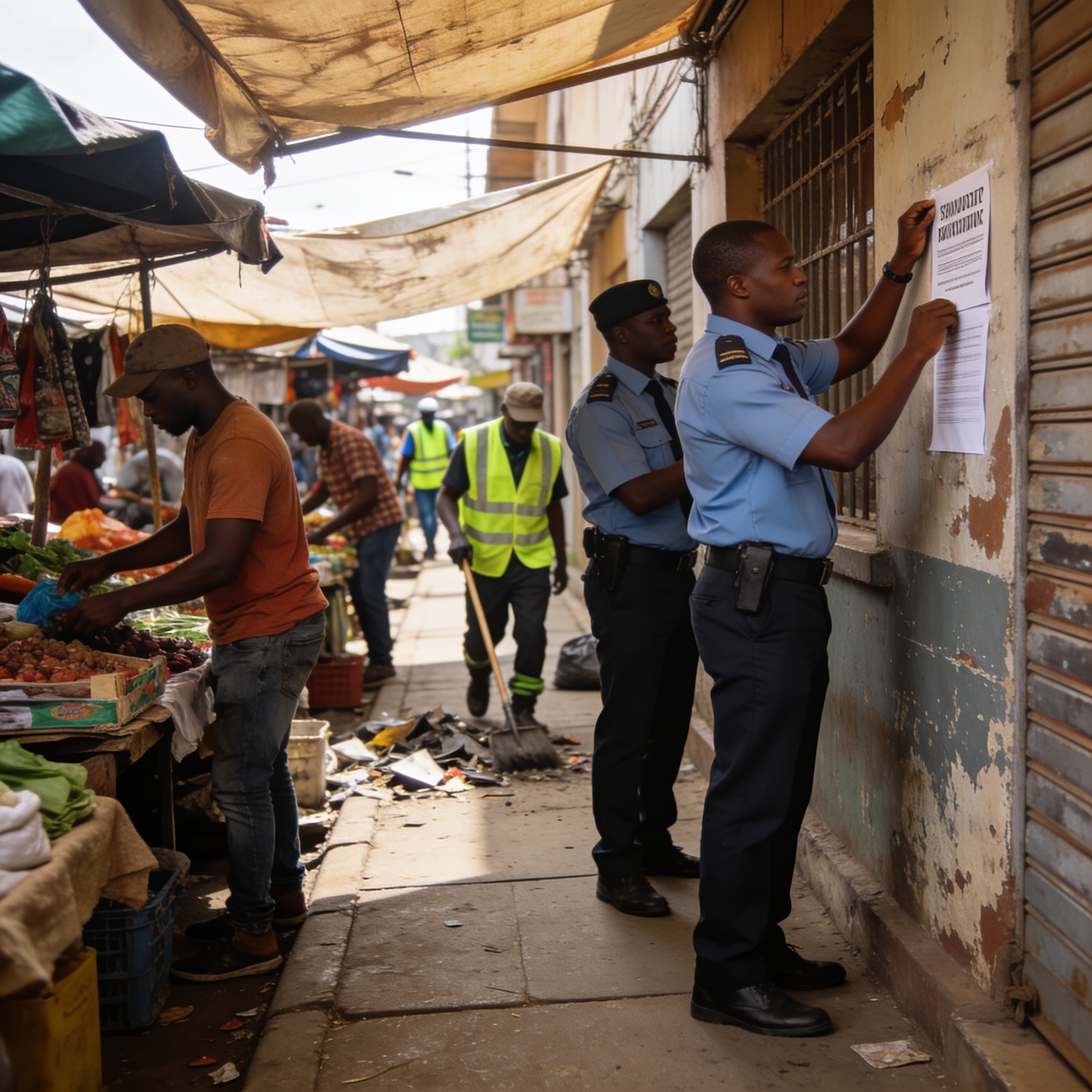
The Zimbabwean government has rolled out a series of sweeping measures aimed at restoring order in urban areas, including new restrictions on vending hours and a crackdown on dilapidated buildings. The directives, announced in Harare on Thursday, take immediate effect across all 92 local authorities.
New Vending Hours for CBDs and Residential Areas
Under the new rules, vendors operating in central business districts (CBDs) will be permitted to trade only between 6am and 6pm. Those operating in residential areas, including high-density suburbs, have until 8pm to close. The announcement was made by Permanent Secretary in the Ministry of Local Government and Public Works, Engineer Tafadzwa Muguti.
“After 6pm, we don’t expect to see anyone doing vending within any business district. And after 8pm, we don’t expect to see any vending within residential communities,” Muguti said. The restrictions are national and not targeted at any particular city or category of trader.
The move is expected to significantly affect thousands of informal traders who depend on late afternoon and evening trade, particularly those selling to commuters returning from work. The government has not yet outlined enforcement mechanisms or penalties for those who violate the new hours.
Property Owners Face Abatement Orders
In a related development, Local Government and Public Works Minister Daniel Garwe directed local authorities to issue abatement orders against property owners and occupiers whose buildings, boundary walls, pavements, yards, and surrounding areas are unsafe, unsanitary, dilapidated, or otherwise unacceptable.
The directive, issued under Section 36, Subsection 4 of the Housing Standards Control Act, covers shopping centres, business complexes, industrial properties, offices, churches, and residential properties. Property owners will be required to carry out repairs, renovations, repainting, and cleaning to bring their premises up to standard.
Failure to comply could result in penalties including a fine up to level five, imprisonment for up to six months, or a bond, depending on the applicable legislation. Garwe also instructed local planning authorities to strengthen enforcement against illegal developments and unauthorised building modifications, with enforcement orders to stop, rectify, or remedy unlawful developments.
National Clean-Up Campaign to Continue Indefinitely
Garwe stressed that the clean-up campaign, which began along ED Mnangagwa Road, is not a once-off exercise but an ongoing programme focused on restoration, enforcement, rehabilitation, and improved service delivery. He called on property owners, businesses, vendors, residents, and other stakeholders to cooperate with local authorities.
“Our cities and towns must be places where people can work, conduct business, move safely and live in clean, orderly environments,” he said. The programme will extend beyond major urban centres to growth points in rural areas.
In Harare, particular attention will be paid to the Central Business District, especially the downtown area and First Street, which Garwe described as an important gateway and commercial corridor.
Government Says It Is Not Targeting Livelihoods
Minister Garwe emphasised that the government was not seeking to stop people from earning a living, but to ensure that informal economic activity takes place lawfully, orderly, and safely. He directed local authorities to immediately renovate and improve existing vending sites to ensure they are safe and suitable for vendors.
The Ministry will also soon release amended Hawkers and Vendors By-Laws, which will introduce updated licensing and control measures, including provisions governing third-party-owned vending and trading sites. Muguti added that 113 bylaws are currently being modified to align with the government’s Vision 2030 agenda.
The new measures come amid ongoing debates about the role of informal trading in Zimbabwe’s economy, where formal employment opportunities remain limited. While authorities argue the clean-up is necessary for public safety and order, traders have long maintained that vending is a vital source of livelihood.