

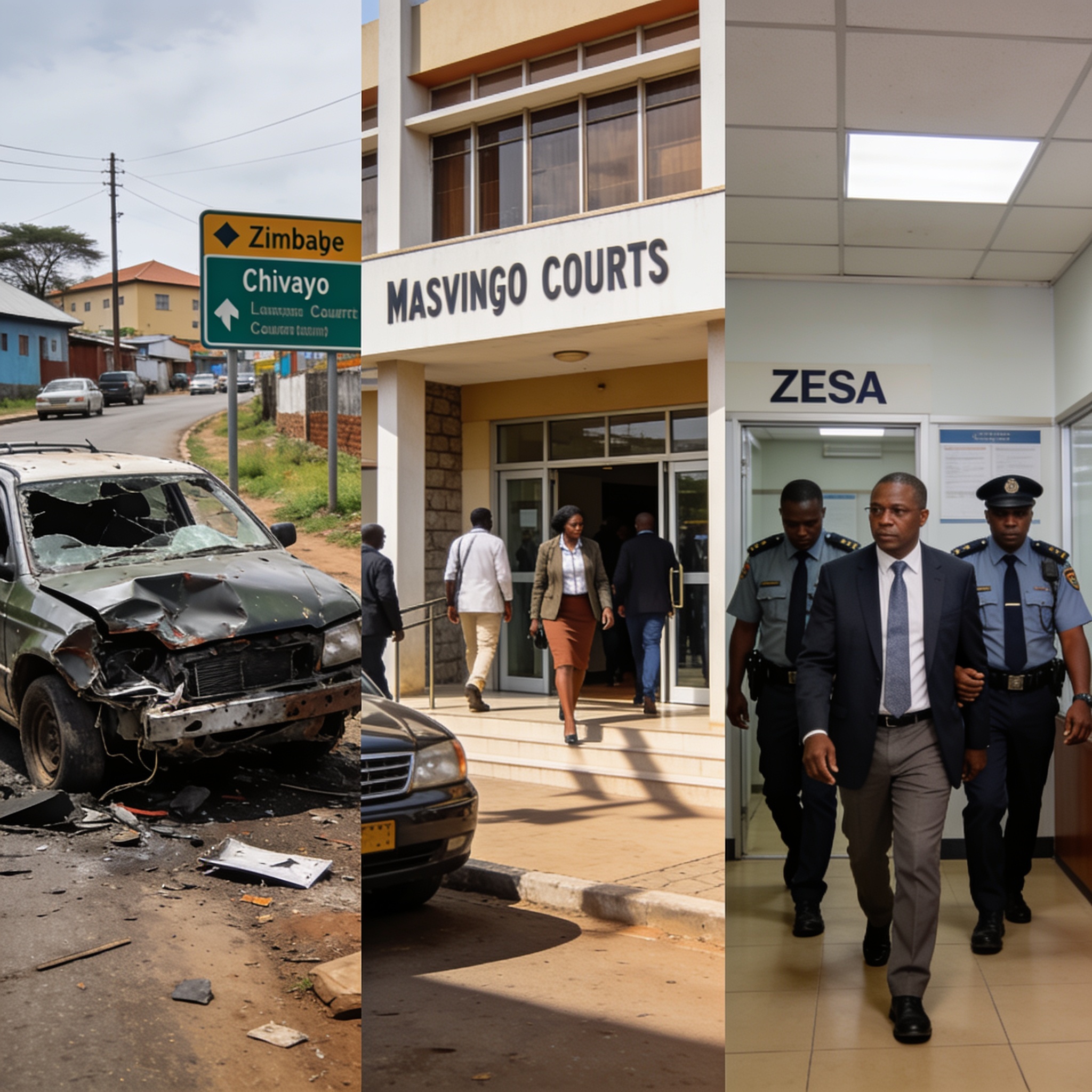
Three Zimbabwe stories to watch
Zimbabwe’s news cycle on 28 September 2026 is dominated by three issues that feel separate but share a common thread: public trust, infrastructure and access to justice. They range from a controversial road crash involving a luxury vehicle linked to a religious figure, to delays at the High Court in Masvingo, to a foiled electricity-theft attempt in Buhera.
1. Chivayo responds to online gloating after fatal crash
Businessman and social figure Wicknell Chivayo has hit out at people he says celebrated after a Toyota Land Cruiser 300 ZX gifted to the late apostolic sect leader Paul Mwazha was involved in a fatal accident near Featherstone. Reports say one person riding with a cattle-drawn scotch cart died at the scene around 8pm as the SUV was travelling towards Harare and was attempting to overtake. The driver of the SUV was seriously injured, while Ngoni Mwazha, son of the late leader, was a passenger. The vehicle had been gifted to Paul Mwazha for his 107th birthday in October 2025 and later passed to his son.
Chivayo, who has publicly promoted large-scale charity, called critics doom-seekers and said he would continue supporting the religious house and uplifting its servants despite noise and attacks. The exchange matters beyond celebrity gossip. In Zimbabwe, major road accidents often become public arguments about morality, wealth, religion and fairness. The crash should first be treated as a road-safety failure and a loss of life, not as a spiritual or political scoreboard.
2. Masvingo High Court backlog exposes judicial capacity crisis
The High Court in Masvingo is reported to be struggling with a serious case backlog because it has only one sitting judge after Justice Sunsley Zisengwe’s transfer to Mutare on 7 September 2026. Appeals in Zimbabwe’s legal system generally require two judges, so with one judge at the station, appeal hearings cannot proceed as normal. Newly appointed Justice Justin Uladi has yet to be deployed, leaving litigants stuck in delay.
The situation is worsened by the High Court rule preventing a judge who conducts a pre-trial conference from presiding over the same case at trial. That means lawyers and litigants may need to move matters to Harare or Bulawayo, increasing costs and emotional strain. This echoes earlier concerns by Justice Rita Makarau in 2023 about the absence of a third judge crippling work at Masvingo. It also recalls how the case involving suspended magistrate Story Rushambwa had to be moved because of a conflict involving one judge. Court capacity is not an administrative detail; it decides whether justice is fast enough to be meaningful.
3. Buhera arrests show theft of power infrastructure is still a threat
In Buhera, police arrested three men after a failed attempt to steal a ZESA transformer and armoured cable at Matias Business Centre. ZRP spokesperson Commissioner Paul Nyathi said the suspects – Isaac Lloyd, Blessing Mudyanadzo and Tanaka Choruwa – abandoned their Toyota Toyoace pickup after community members found them vandalising the equipment. They were later taken into custody on a Harare-bound bus near Murambinda Business Centre on 24 September. A fourth suspect, Peter Chuma, is reported to be at large.
Theft and vandalism of electrical infrastructure remains one of Zimbabwe’s most damaging economic crimes. Transformers and cables are not ordinary spare parts; when they are removed, businesses lose production, households lose power, and local government credibility weakens. The Buhera case shows that community vigilance can work, but the real test will be whether the legal system can process such cases quickly enough to deter repeat offenders.
What this means for readers
Put together, the stories ask hard questions of public figures and state institutions. Should social media rush to mock tragedy, or should road-safety lessons dominate the conversation? Should Masvingo litigants be forced to travel for justice while one judge carries an entire caseload? Should power infrastructure theft be treated as an emergency every time it threatens a township or growth point? The answers point to the same place: better institutions, fair accountability and safer public services.