

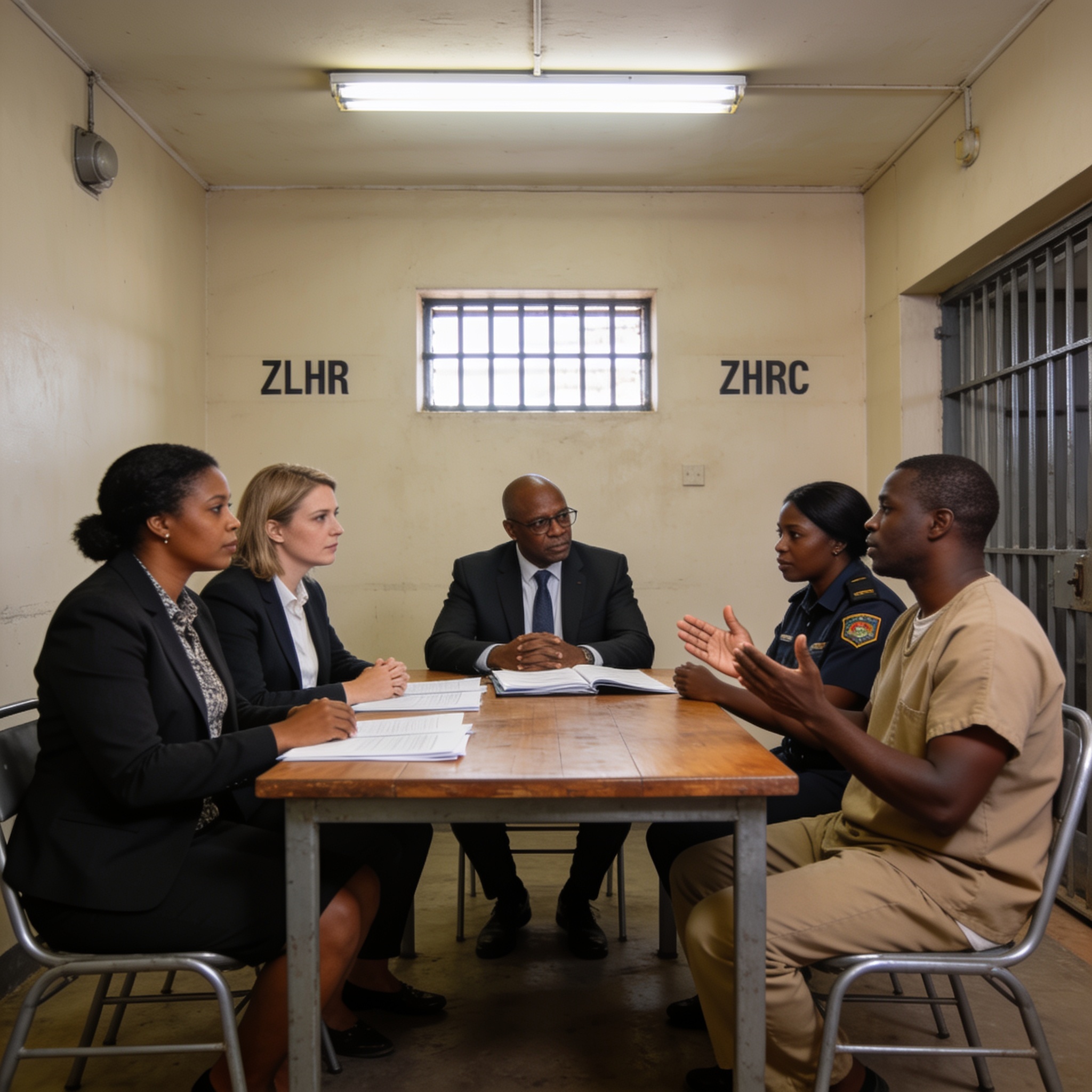
Zimbabwe’s leading human rights law firm has taken its concerns about the treatment of inmates with communication disabilities to the country’s constitutional watchdog, pressing the Zimbabwe Human Rights Commission (ZHRC) to carry out physical inspections of the country’s prisons and remand facilities.
The Zimbabwe Lawyers for Human Rights (ZLHR) confirmed that it lodged the request with the commission in a letter dated 17 September 2026, arguing that the ZHRC is legally obliged to establish the conditions under which deaf, mute and hard-of-hearing prisoners are being kept.
What the lawyers are asking for
The petition was authored by lawyers Obey Shava and Obey Chitowamombe, who want the commission to interrogate several specific aspects of life behind bars for inmates who cannot hear or speak. Their request covers:
- Access to communication and interpretation, including Zimbabwe Sign Language
- Access to information about proceedings, rights and daily routines
- Personal safety mechanisms and protection from abuse
- Health care, rehabilitation programming and other essential services
The lawyers contend that a facility visit would allow the commission to discharge its obligations under Section 243(1)(k) of the Constitution, which empowers the ZHRC to enter and inspect prisons, places of detention and related facilities, to assess the circumstances of those held there and to recommend remedies to the Minister responsible for their administration.
Beyond a physical inspection, ZLHR has urged the commission to consider launching a formal investigation under Section 243(1)(f) of the Constitution to determine whether the rights of deaf and mute detainees in the custody of the Zimbabwe Prisons and Correctional Services (ZPCS) have been violated or are currently being violated.
The organisation also wants the commission to write directly to the affected inmate, setting out what steps it intends to take on the request and what comes out of any inspection it conducts.
The case that triggered the petition
The request for the ZHRC’s intervention flows from the prosecution of Fanuel Masora, a deaf and mute man who communicates solely through Zimbabwe Sign Language.
Masora was originally charged with murder before the High Court convicted him on 4 March 2026 of culpable homicide, an offence defined under Section 49 of the Criminal Law (Codification and Reform) Act. He was handed a three-year prison term, wholly suspended for five years, and ordered to complete 420 hours of community service at Deaf Zimbabwe Trust.
In her ruling, High Court judge Justice Emilia Muchawa placed Masora in a special category of persons with disabilities who have endured severe social isolation and persistent barriers to taking part in ordinary social life. The judge also weighed the obstacles he had faced while in detention, particularly whether he would be able to understand and comply with a custodial sentence.
Why communication barriers matter in custody
According to Shava and Chitowamombe, the Masora matter exposes the deeper vulnerabilities that deaf people encounter inside Zimbabwe’s criminal justice and correctional systems. They argue that where interaction with prison officers, access to information, safety arrangements and participation in rehabilitation depend on effective communication, inmates who cannot hear or speak are effectively shut out.
Their client’s experience, they say, is not an isolated one but illustrative of systemic gaps that the ZHRC is uniquely placed to document and address.
The petition adds to mounting scrutiny of conditions in Zimbabwean detention facilities, where disability inclusion has rarely featured in official reporting. Should the commission act on the request, its findings and recommendations to the responsible Minister could set a precedent for how ZPCS handles inmates with hearing and speech impairments in future.
The ZHRC has not yet publicly indicated whether it will accede to the request for an inspection or the proposed investigation.